
EPBD 2024/1275: What Changes for Building Automation, Controls and EV Charging in New Buildings (a Guide for Engineers in Greece)

In short: The recast Energy Performance of Buildings Directive (EPBD, 2024/1275) had to be transposed by 29 May 2026. Greece, like the other member states, is late, but the obligations are coming. For anyone designing or building today, three points matter right away: monitoring and controls in new homes, building automation (BACS) and automatic lighting control in commercial buildings, and pre-cabling for EV charging. A building designed now will be handed over when the rules already apply.
Key deadlines
| Obligation | Which buildings | Deadline |
|---|---|---|
| Zero-emission buildings | New public buildings | 1/1/2028 |
| Zero-emission buildings | All new buildings | 1/1/2030 |
| Monitoring, control, response to signals | New homes and major renovations | From 29/5/2026 (where feasible) |
| Building automation and control system (BACS) | Non-residential over 290 kW | 31/12/2024 |
| Building automation and control system (BACS) | Non-residential over 70 kW | 31/12/2029 |
| Automatic lighting control | Non-residential over 290 kW / 70 kW | 31/12/2027 / 31/12/2029 |
| EV pre-cabling | Residential with more than 3 parking spaces | On transposition |
The kW thresholds refer to the effective rated output of heating, air-conditioning or combined ventilation systems.
Where Greece stands
- The transposition deadline was 29 May 2026 and passed without a Greek law.
- In July 2026 the European Commission sent letters of formal notice to all 27 member states for non-transposition.
- Greece submitted its draft National Building Renovation Plan on 2 July 2026. The final plan is expected by year end.
The delay does not change the direction. The Directive's requirements are specific and Greek law will have to adopt them. The safest strategy for designers and builders is to design to the Directive now, so no changes are needed at the end.
Homes: monitoring, control and response to signals
Article 13(11) is the most interesting change for homes. It requires member states to ensure, where technically, economically and functionally feasible, from 29 May 2026, that new residential buildings and those undergoing major renovation have:
- Continuous electronic monitoring that measures system efficiency and informs the owner when there is a significant variation or when servicing is needed.
- Effective control functionalities for optimal generation, distribution, storage and use of energy and, where applicable, hydronic balancing.
- The capacity to react to external signals and adjust consumption, for example to electricity prices or grid signals.
Single-family houses under major renovation may be exempted where installation costs exceed the benefits.
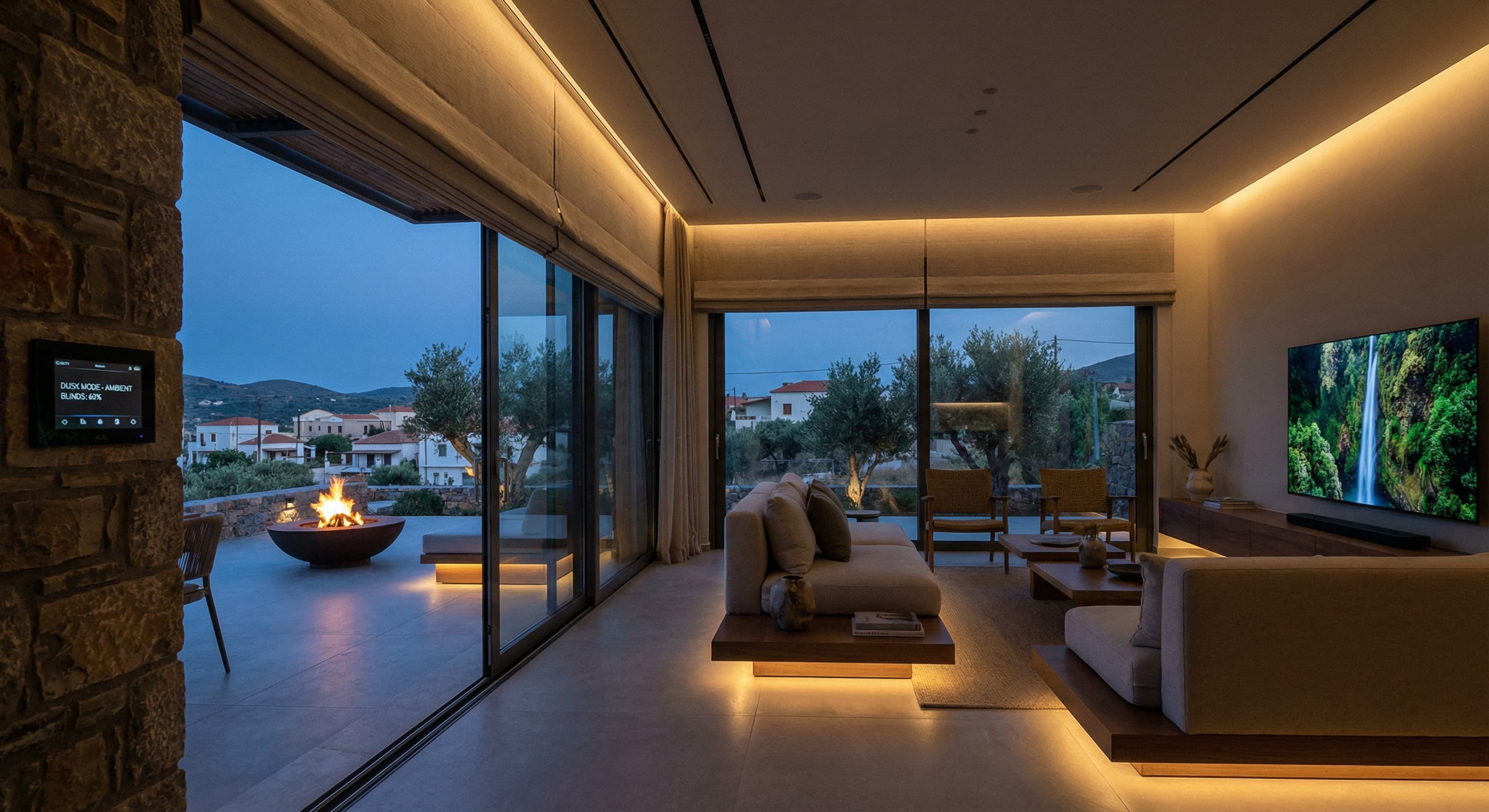
In practice, this is exactly what a well-designed KNX system does: it meters per circuit, controls heating and cooling per zone, alerts on faults and responds to external signals such as dynamic tariffs.
Commercial buildings and hotels: BACS and lighting
For non-residential buildings, Article 13 requires, where technically and economically feasible, a building automation and control system (BACS):
- over 290 kW by 31/12/2024 (already past),
- over 70 kW by 31/12/2029.
The 70 kW threshold covers most hotels, offices and mid-sized shops. The Directive also sets what the system must be able to do:
- continuously monitor, log and analyse energy use and allow it to be adjusted,
- benchmark efficiency, detect losses in efficiency and inform the facility manager,
- communicate with connected systems and be interoperable across technologies and manufacturers,
- from 29/5/2026, monitor indoor environmental quality.
The same buildings also need automatic lighting controls, suitably zoned and with occupancy detection: over 290 kW by 31/12/2027 and over 70 kW by 31/12/2029. For sensor choice, see our guide to PIR and mmWave sensors.
The cross-manufacturer interoperability requirement matters. KNX is an open international standard (ISO/IEC 14543) with hundreds of manufacturers, so it meets this requirement by design. A closed single-vendor system struggles.
EV charging
Article 14 changes how parking is designed:
- New residential buildings and major renovations with more than 3 parking spaces: pre-cabling for at least 50% of spaces, ducting for the rest, and at least two bicycle parking spaces per dwelling. New residential buildings also need at least one recharging point.
- Non-residential buildings with more than 5 spaces: at least one recharging point per 5 spaces, pre-cabling for at least 50% and ducting for the rest.
Pre-cabling is half the job. When many cars charge at once in an apartment building, load management is needed so the supply capacity is never exceeded. That is designed together with the electrical panel and the automation, not afterwards.
The Smart Readiness Indicator (SRI)
The SRI rates how smart a building is: how well it adapts to its occupants, to the grid and to its own operation. It is currently voluntary, and the Directive foresees applying it first to large non-residential buildings. Every designer should still keep it in mind: the SRI criteria (heating, lighting and shading control, monitoring, grid response) are a good map of what "smart building" means in European practice.
Checklist for designers and builders
- In the project specification, require an open-standard automation system with energy metering, per-zone heating and cooling control and the ability to respond to external signals.
- In the electrical panel, leave space for energy meters and actuators, and plan the bus cabling from the start.
- In the rooms, provide presence and air quality sensors (CO2, humidity) where they will be needed, especially in commercial spaces.
- In the car park, ducting and pre-cabling per Article 14, and panel space for charger load management.
- In the data network, a proper network that will serve remote monitoring securely.
- In the documentation, keep drawings and system programming, as they will be needed for energy certification and maintenance.
How Sync-Teq helps
We work with architects, engineers and builders from the design stage: automation specifications, panel and cabling design, programming and handover of the KNX system. The goal is a building that meets the Directive from day one, without costly changes after handover. Contact us about your next project.
Sources
Frequently asked questions
What is the EPBD 2024/1275?+
It is the recast EU Energy Performance of Buildings Directive. It makes all new buildings zero-emission buildings from 2030 and introduces requirements for building automation and control systems, automatic lighting controls, solar readiness and EV charging infrastructure. The transposition deadline was 29 May 2026.
Has Greece transposed the EPBD?+
Not yet, at least as of early October 2026. The 29 May 2026 deadline passed and in July the European Commission sent letters of formal notice to all 27 member states. Greece submitted its draft National Building Renovation Plan on 2 July 2026.
Is home automation mandatory in new homes under the EPBD?+
Article 13(11) requires member states to ensure, where technically, economically and functionally feasible, from 29 May 2026, that new residential buildings and those undergoing major renovation have continuous electronic monitoring of system efficiency, effective control functionalities and the capacity to react to external signals. Single-family houses under major renovation may be exempted where costs exceed benefits.
Which buildings need a building automation and control system (BACS)?+
Non-residential buildings whose heating, air-conditioning or combined ventilation systems have an effective rated output over 290 kW by 31/12/2024, and over 70 kW by 31/12/2029, where technically and economically feasible. In practice the 70 kW threshold covers most hotels, offices and mid-sized shops.
What does the EPBD require for EV charging in apartment buildings?+
For new residential buildings and residential buildings undergoing major renovation with more than three parking spaces: pre-cabling for at least 50% of spaces, ducting for the rest, and at least two bicycle parking spaces per dwelling. New residential buildings also need at least one recharging point.
What is the Smart Readiness Indicator (SRI)?+
A common EU scheme that rates how smart a building is: how well it adapts to its occupants, to the grid and to its own operation. It is currently voluntary, and the Directive foresees applying it first to large non-residential buildings.
Related Articles
KNX vs Zigbee / Z-Wave / Thread / Matter: What Goes Where (Wired Backbone, Wireless Edge)
What should be infrastructure (backbone) and what can be edge? A practical guide to correct Smart Home architecture.
Read more →
Smart Home is not a Wi-Fi bulb — it's the system
Most people start with a Wi-Fi bulb. But that's usually remote control, not automation. A truly smart home is infrastructure: reliable, logical, scalable.
Read more →