
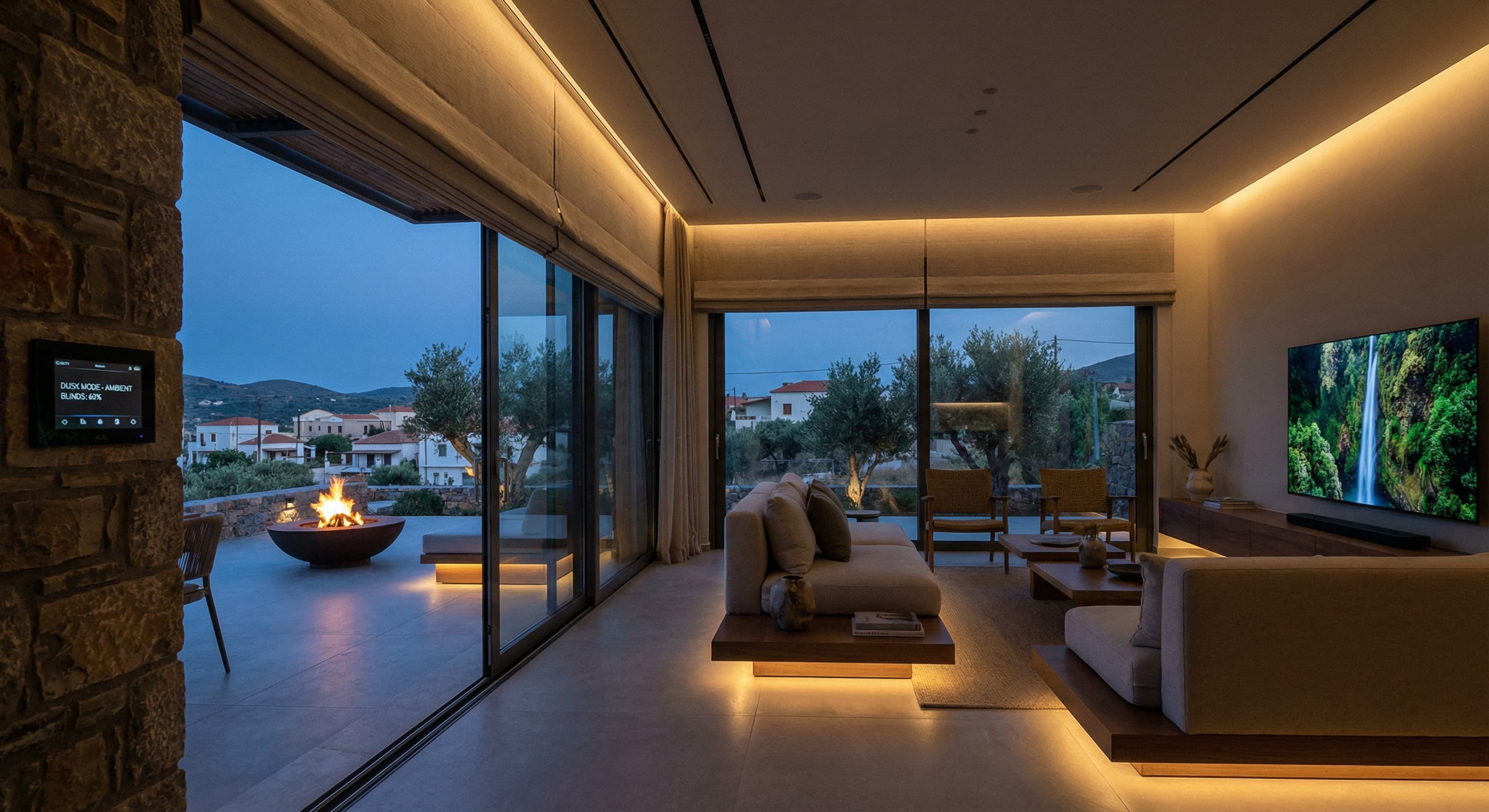
Smart Home is not a Wi-Fi bulb — it's the system

Most people "enter" the smart home world with a Wi-Fi bulb or a smart plug. It's a nice first step: turn on/off from mobile, set a timer, say "done". But this is usually remote control, not automation.
A truly smart home (and a properly designed smart building) is infrastructure: it works consistently, has logic, scales, and doesn't collapse when the router changes or the internet goes down.
From "App" to "System"
- Smart gadget: one device + one app + (often) cloud.
- Smart home / smart building: a set of rules, sensors, scenes, and subsystems that work together.
Gadget Example: "Turn on the lamp from the phone."
System Example:
- "When it gets dark and there is motion in the hallway, turn on lighting at 20% for 2 minutes."
- "When Movie Mode starts, dim living room lights, close blinds, turn on bias light, activate AVR."
- "When everyone leaves, turn off non-critical loads, set HVAC to eco, arm security scenario."
The latter is what makes daily life more comfortable — not searching for apps.
Why Should You Care?
For Homeowners
- Comfort: scenes with one touch, not "10 moves".
- Security: panic lighting, presence simulation, meaningful notifications.
- Economy: HVAC/blinds/lighting work "smartly", not blindly.
- Less Friction: the house "understands" instead of tiring you.
For Developers / Engineers / Designers
- Specify functions, not brands: "scene logic", "occupancy-based HVAC", "daylight harvesting".
- Better Integration: lighting, shading, HVAC, energy metering, BMS-like logic.
- Reliability & Maintainability: documentation, layer separation, scalability.
- Risk Reduction: less dependence on clouds/accounts/apps that change.
What's Wrong with "Wi-Fi Logic"?
It's not "bad". It's just a different category.
Common problems when a house is built from gadgets:
- Too many apps / too many ecosystems → chaos.
- Cloud dependence → if policy/servers change, operation changes too.
- Network instability (router, Wi-Fi coverage, IP changes) → "something isn't working again".
- Zero orchestration → everything is an island, not an orchestra.
If the goal is "to turn on a lamp from the mobile", fine. If the goal is for the house to function better, you need a system.
What Proper Architecture Looks Like
Think of it as 3 levels:
- Infrastructure (ideally wired for criticals) Lights, blinds, HVAC interlocks, basic functions that must always work.
- Wireless Where It Makes Sense Sensors/retrofit points/supplements (Zigbee / Z-Wave / Thread / Matter) — when wiring isn't practical or flexibility is needed.
- Logic & Integration Scenes, rules, dashboards, integrations (home cinema, multiroom audio, cameras/network) without "swallowing" the installation's reliability.
The Quick Test: Is It Really "Smart"?
Answer "yes/no":
- If the internet goes down, do the basics work (lighting/blinds/heating)?
- Is there manual control that always works (switches/local commands)?
- Are there scenes (Movie, Night, Away) and not just apps?
- Is there logic with sensors, not just voice commands?
- Can it expand without becoming a "mess"?
If most are "yes", then we are talking about a smart home / smart building.
Related Articles
5 Common Myths About Smart Homes Debunked
Is a smart home only for the tech-savvy? Too expensive? We separate fact from fiction and explore the reality of modern home automation.
Read more →
EPBD 2024/1275: What Changes for Building Automation, Controls and EV Charging in New Buildings (a Guide for Engineers in Greece)
The recast Energy Performance of Buildings Directive brings automation and control requirements for homes and commercial buildings, automatic lighting controls and EV pre-cabling. What applies, the deadlines, and how to design for it now.
Read more →