
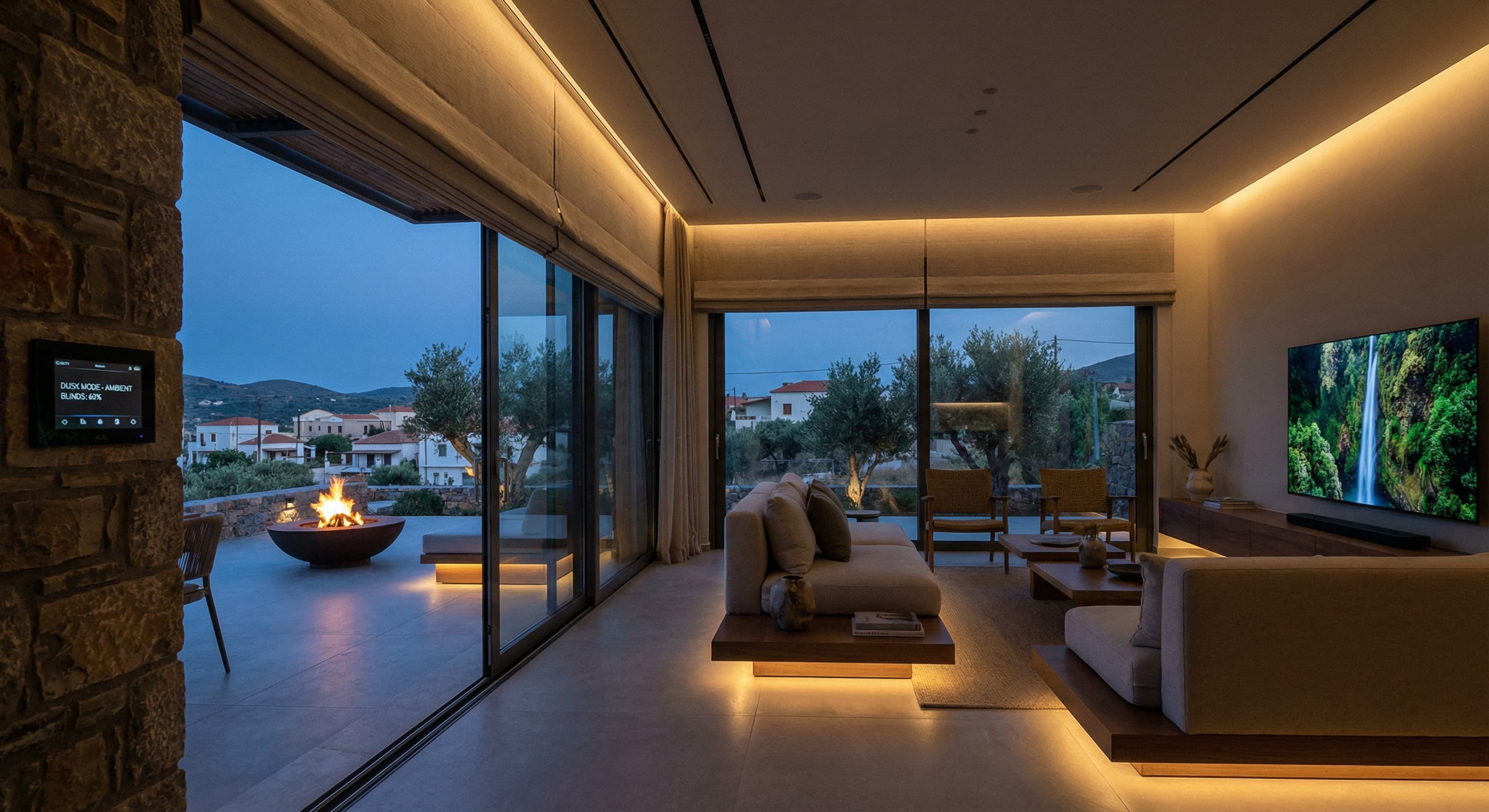
5 Common Myths About Smart Homes Debunked
The term "Smart Home" often brings to mind sci-fi movies or a collection of "impressive" gadgets that need tweaking every week. In practice, a properly designed smart home doesn't aim to look smart — it aims to make life simpler, the home safer, and consumption more efficient. Let's debunk the most common myths.
Myth 1: It's Only for Tech Gurus
Fact: A well-designed smart home should be easier to use than a traditional one. You shouldn't need a manual to turn on the lights. Basic functions remain simple and natural (switch, button, scene), while the "smart" logic works in the background.
At SyncTeQ, we design user experiences with few, clear options:
- 1 press for "Welcome" (lights, blinds, temperature)
- 1 press for "Goodnight" (all off, arm security, night lighting, eco HVAC)
A smart home shouldn't require you to think "technologically" — it should work humanly.
Myth 2: It's Too Expensive
Fact: Technology is scalable — and the cost makes sense when applied correctly. You can start targeted (e.g., lighting + blinds or HVAC zoning) and expand later without ripping out walls.
The key is a proper foundation from the start (design, wiring where needed, correct network/panel structure) so that every subsequent addition is an extension, not a "patch". And yes: energy savings from proper HVAC/shading management can, over time, offset a significant part of the investment.
Myth 3: It's Just a Gadget Without Substance
Fact: Automation isn't just about changing colors on a bulb. It's solutions to real problems:
- Security & Deterrence: presence simulation when away, lighting scenes, "Away" automations.
- Home Protection: smoke, CO, water leak detection, notifications with escalation (e.g., closing water valve).
- Meaningful Comfort: correct lighting per activity, scenes, night path lighting.
- Efficiency: automated HVAC based on presence, schedules, thermal zones, shading based on sun/temperature.
"Smart" isn't the effect. It's the cooperation of subsystems.
Myth 4: If the Internet Goes Down, the House Stops Working
Fact: This applies mainly to purely cloud-based DIY devices. Professional automation systems — like KNX — work locally. This means:
- switches, sensors, and automations continue to work,
- basics (lights/blinds/HVAC) do not depend on third-party servers.
The internet is useful for remote access and updates — not for turning on the living room light.
Myth 5: "Hackers Will Control My Home"
Fact: Security is not a slogan — it's architecture. In professional installations, we apply practices such as:
- network segmentation (VLANs) for IoT/cameras/infrastructure,
- secure remote access (VPN, not "open" ports),
- controlled gateways and limited permissions,
- where required, encryption and modern standards (e.g., KNX Secure).
Simply put: a smart home shouldn't be "a device on Wi-Fi". It should be infrastructure with security rules, just like a business network.
When It's NOT Worth It
A smart home isn't mandatory for everyone — and that's OK. It's usually not worth it if the goal is simply "to turn on 1–2 lights from my phone" without interest in scenes/sensors, for temporary spaces (e.g., short-term rental), or when there's no intention for even a basic design study to ensure reliability and scalability. In these cases, a simple DIY solution can cover the need without excess — as long as we know we're talking about a convenience gadget, not automation infrastructure.
Summary
A proper smart home is:
- simple to use,
- reliable without internet,
- secure by design,
- and scalable without becoming a "mess".
Related Articles
Cyber Resilience Act: What Changes for Smart Device Security and What to Look for When Buying
From September 11, 2026, IoT manufacturers must report actively exploited vulnerabilities within 24 hours. The EU is finally setting rules for smart home security. Here's what it means for you.
Read more →
Smart Home is not a Wi-Fi bulb — it's the system
Most people start with a Wi-Fi bulb. But that's usually remote control, not automation. A truly smart home is infrastructure: reliable, logical, scalable.
Read more →