Industry details
Yachts & Marine
Compact, salt-air-resistant, and rock-solid. We engineer automation systems built for life at sea, from cabin climate and lighting to navigation-linked controls.
In short
SyncTeQ is a certified KNX Partner based in Chalandri, Athens, that designs and programs automation for yachts and leisure boats in Greece. We bring lighting, cabin climate control, shading, audio and video and the onboard network together in one system, run from push buttons, touch panels and an app. Control runs locally, so nothing depends on an internet connection at sea, and when the boat is in port we can provide remote support over a secure connection. We work alongside the shipyard and the boat's electrician.
One system instead of many remotes
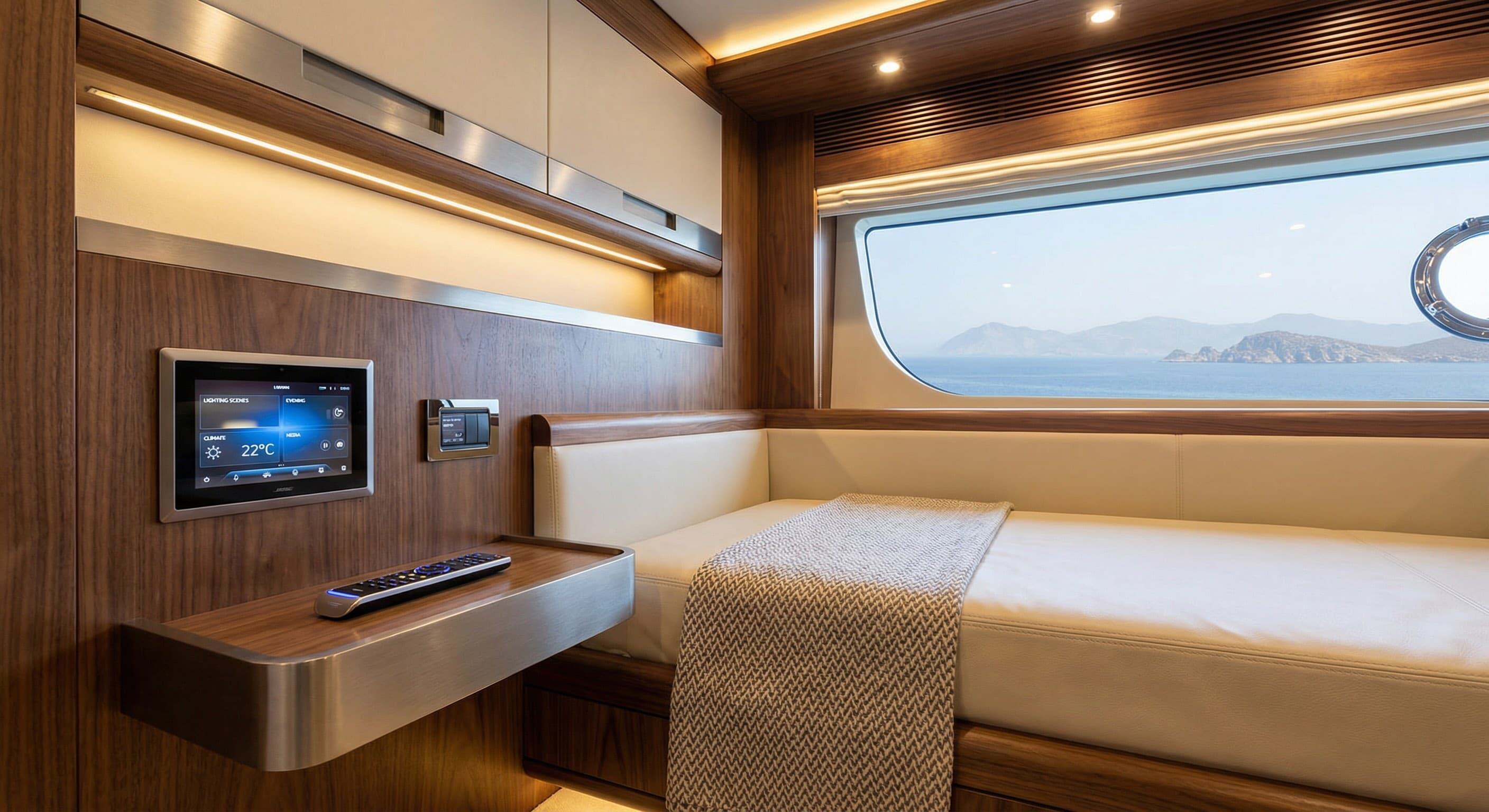
On a boat space is tight, and each system usually has its own controls: switches for the lights, thermostats in the cabins, remotes for the audio, a separate app for the network. Automation brings them together in one system with a few clear push buttons, touch panels and an app, so the owner, guests and crew can do what they need without instructions. The logic is the same as in a well designed home: a system, not gadgets.
What we integrate on board
| System | What is controlled |
|---|---|
| Lighting | Scenes for saloon, cabins and deck, dimming, night and corridor lighting |
| Climate | Temperature per cabin, economy when a cabin is not in use |
| Shading | Curtains, blinds and shades in scenes |
| Audio and video | TVs, zoned audio, entertainment sources, a movie scene |
| Network | Wi-Fi for guests and crew, a separate network for control systems |
| Monitoring | Indicators and alerts for key system parameters |
Lighting and scenes
Lighting changes the feel of a boat more than anything else. With scenes, one button sets the saloon for dinner, another switches on the deck lighting for boarding, and a goodnight button turns everything off except a low corridor light. On larger boats DALI gives control per light fitting, as we explain in our guide to DALI lighting control.
Climate and shading
Climate is controlled per cabin, within limits set by the owner or captain, and can drop to economy when a cabin is not in use. Curtains and shades are part of the same scenes as the lighting, for privacy in port or protection from the sun. The logic of shading is covered in our guide to shading automation, and climate control on our HVAC and energy optimization page.
Audio, video and entertainment
In the saloon and cabins we design audio and video to suit the available space, with zoned audio so different music can play on deck and in the saloon. Everything is controlled from the same push buttons and app as the rest of the automation. See our home cinema and multiroom audio service.
The onboard network
The network carries streaming, control apps, cameras and remote access. We design wired access points for good coverage in a space with a lot of metal, separate the guest network from the crew and control networks, and organise whatever internet connections the boat has, such as mobile or satellite. More in our guide to the network and our networking and cybersecurity service.
Monitoring and alerts
The owner or captain wants to know that everything is fine, even when nobody is on board. With temperature and humidity sensors in the spaces and alerts for climate or network faults, a problem shows up early, before it bothers the guests. When the boat is connected, alerts reach a phone. More on our IoT and predictive maintenance page.
Reliability and local control
At sea there is no room for a system that waits for a reply from a cloud server. That is why control runs locally, physical push buttons keep working when a screen or phone is not available, and the architecture stays simple and documented. The difference between local and cloud control is explained in local vs cloud and KNX vs Wi-Fi. We work with the shipyard and the boat's electrician on equipment positions, mounting and protection, while navigation, propulsion and safety systems remain their responsibility.
How we work on a boat
- Inspection and drawings. We study the boat's drawings, the available spaces and the existing cabling.
- Functional design. With the owner and captain we decide what is controlled in each space, and from where.
- Coordination with the shipyard. We give clear specifications for cabling, positions and panels.
- Programming and testing. Every function is tested on board before handover.
- Handover and training. The crew receives the documentation and learns to operate the system.
Remote support in port
When the boat is in port and connected, we can log in remotely over a secure VPN, with no ports opened to the internet, as described in our guide to KNX security. Many changes and fixes can then be made without a visit. Support is billed hourly or under a monthly contract with guaranteed response time, and the crew is trained to operate the system. For how we work, see our KNX and smart automation page.
Frequently asked questions
Does the yacht's automation need internet to work?+
No. Scenes, lighting, climate and shading run locally on the boat's control network. That matters a lot at sea, where mobile or satellite connections can be unstable. Internet is only used for remote access, notifications and support, when it is available.
What can be automated on a yacht?+
Typically saloon, cabin and deck lighting with scenes, climate control per cabin, curtains and shades, audio and video in the saloon and cabins, and monitoring of key system indicators. The exact scope is defined in the design stage with the owner, the captain and the shipyard, depending on the boat.
Does the automation replace the boat's navigation or safety systems?+
No. Navigation, propulsion and safety systems, as well as the boat's main electrical installation, remain the responsibility of the shipyard and its specialists. The automation we design covers comfort and hospitality: lighting, climate, shading, entertainment, network and monitoring, and it works alongside the other systems where this is planned.
How does support work when the boat is far away?+
When the boat has a connection, usually in port, we can connect remotely over a secure VPN, see what is happening and make changes without a visit. Support is billed hourly or under a monthly contract with guaranteed response time. The crew is trained to handle the basics on board.
How is reliability ensured in a marine environment?+
Through a simple, well documented architecture: local control with no cloud dependency, physical push buttons that keep working when a screen or phone is not available, equipment suited to where it is installed, and coordination with the shipyard on positions and protection. Documentation is handed over to the owner and the crew.
Can an existing boat be upgraded?+
Often yes, mainly during a refit, when panels and linings are opened up. The scope depends on the available space, the existing cabling and what the shipyard allows. We start with an inspection of the boat and suggest what is worth doing now and what can be added later.
Related guides
- Local vs Cloud in Smart Home: What you risk when 'everything goes through a server'
- KNX vs Wi-Fi Smart Home: Why Choose Professional Automation
- Network: Why Without Proper LAN/Wi-Fi, All 'Smart' Things Become a Problem
- Is KNX Secure? What the Attacks Taught Us and How to Protect a Smart Home in 2026
- Shading Automation: Comfort, Savings, Privacy (and why 'Weather + Sun' matter more than you think)
- Lighting: On/Off vs Dimming vs DALI, and what 'good atmosphere' means
Relevant services
Plan your project with an integration-first approach
From initial consultation to long-term support, we engineer systems that work together from day one.
Contact Us