
Industry details
Hotels & Hospitality
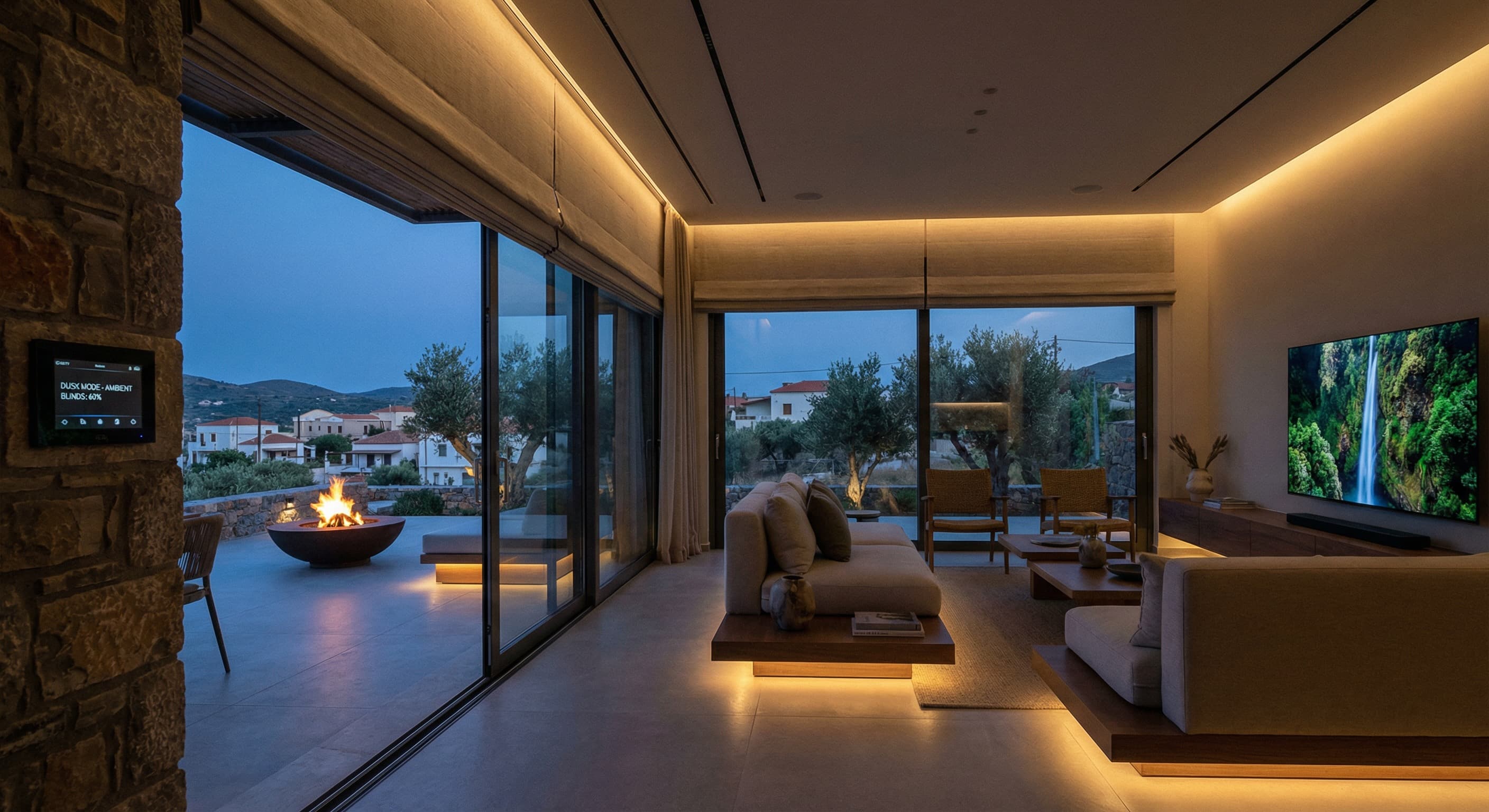
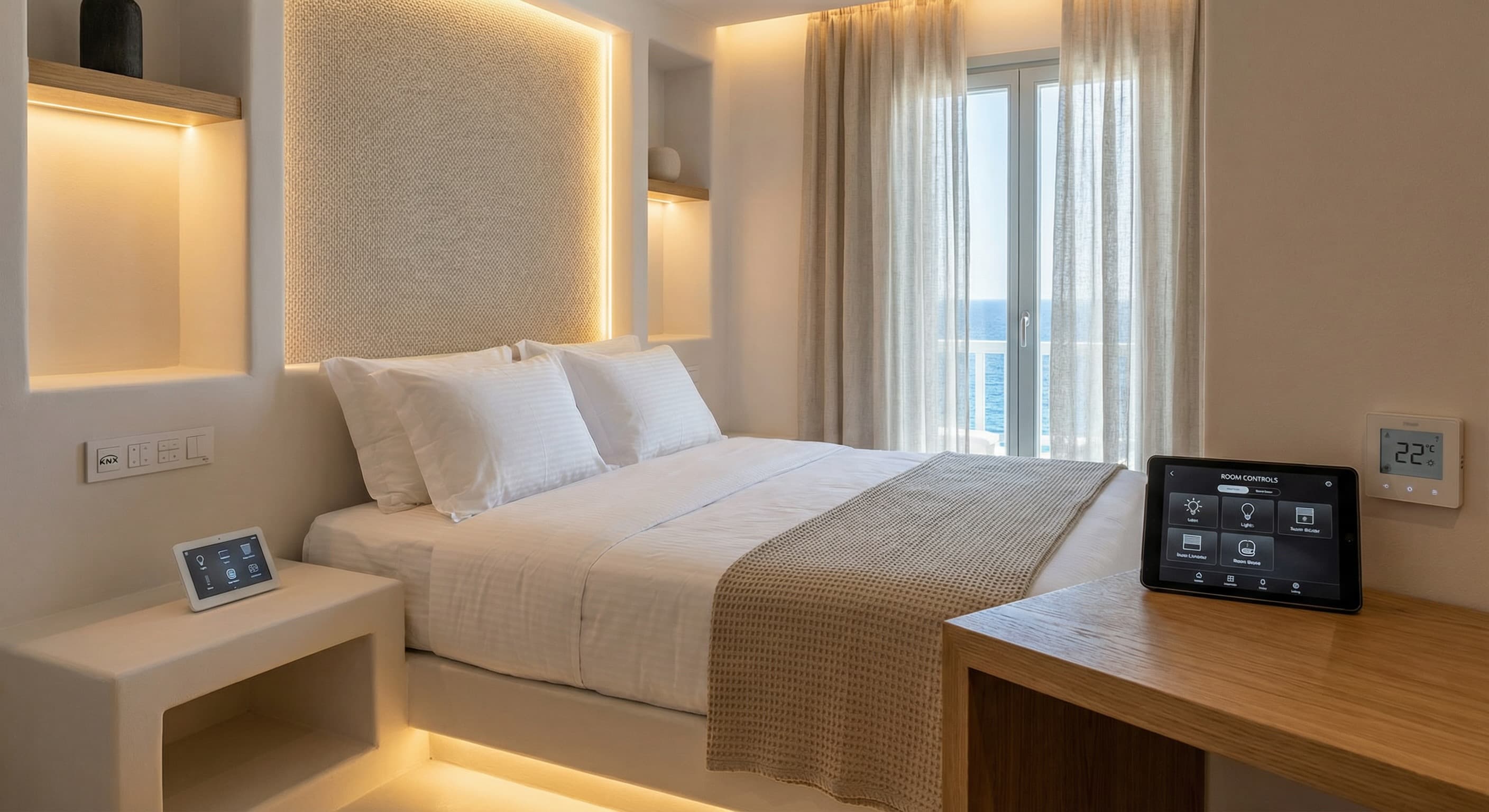
Elevate the guest experience while reducing operating costs. Our hotel automation covers room management, energy optimization, and seamless front-desk integration.
In short
SyncTeQ is a certified KNX Partner based in Chalandri, Athens, that designs automation for hotels, boutique properties and rental rooms across Greece. With a KNX guest room management system (GRMS), every room knows whether it is occupied, empty or being cleaned: climate control drops to economy when the room empties or the balcony door opens, and reception and maintenance see every room on one screen. We also design the guest network and CCTV, and offer support with guaranteed response time during the season.
The room as a system
In a hotel without automation, running costs depend on guest behaviour: air conditioning left on while guests are at the beach, a balcony door open with the unit still running, lights forgotten all day. A KNX guest room management system (GRMS) treats the room as a whole with rules that protect comfort and consumption at the same time. The logic is explained in our guide to hotel energy.
Room states
Instead of "motion means on", the room works with states:
| State | How it is detected | What the room does |
|---|---|---|
| Vacant, not let | From reception or the booking system | Climate in protection mode, lights off |
| Preparing for arrival | Command from reception shortly before check-in | Pre-cooling or pre-heating, welcome scene |
| Occupied | Key card, door contact and presence sensor | Comfort settings, lighting scenes |
| Temporarily empty | Guest has gone out, no presence detected | Climate in economy, non-essential loads off |
| Night | Goodnight button or time of day | Low-level path light to the bathroom |
| Housekeeping | Staff card or command | Full working light |
| Balcony door open | Door contact | Climate to economy or off, after a delay |
Presence: card, sensor and door together
The classic key card holder has gaps, such as a second card left permanently in the slot. That is why we combine the card with a door contact and a presence sensor. A PIR sensor catches movement at the entrance well, while a radar (mmWave) sensor also detects a guest reading or sleeping without moving, so the room does not switch off while someone is inside. Which one fits where is covered in PIR vs mmWave.
Climate and energy
Air conditioning is usually the largest load in a room. Fan coils are driven by KNX actuators, while split units and VRV/VRF systems connect through a gateway: one per indoor unit, or one central gateway for many units, which suits larger buildings. See our guide to VRV/VRF control with KNX. We can limit the temperature range guests can set, add energy metering per floor or building and automate shading on the sunniest facades. More on our HVAC and energy optimization and integrated energy management pages.
A central view for reception and maintenance
A supervision screen shows the status of every room: occupied or not, temperature, open balcony doors, do not disturb and make up room requests. Maintenance sees faults and alarms, such as a water leak or an air conditioner in error, before a guest reports them. Where the booking system allows it, check-in and check-out update the rooms automatically. Common areas such as the lobby, corridors, restaurant and outdoor lighting run on schedules, sensors and, where it fits, DALI lighting control.
Guest network and CCTV
Wi-Fi is one of the first things guests judge. We design wired access points covering rooms and outdoor areas, and separate the guest network from the management, camera and automation networks with VLANs and a firewall. Cameras record locally to an NVR on their own network, and remote viewing is set up securely, without open ports. See our guides to the network and security cameras, and our networking and cybersecurity service.
Small hotels and rental rooms
Automation is not only for large properties. In a small hotel or a set of rental rooms we start with the essentials: per-room climate control, a balcony door contact, switch-off when the room empties and an overview of all rooms on the owner's phone. In existing buildings we use actuators in the distribution board and wireless KNX RF, so the work can be done off-season with little disruption.
How a hotel project starts
- Site survey and data. We look at the rooms, the HVAC, the distribution boards and the network, and ask for energy bills and occupancy figures.
- A model room. We design the logic for a typical room and test it before rolling it out across the building.
- Off-season installation. The work is scheduled so it does not disrupt operation.
- Staff training. Reception, maintenance and housekeeping learn what they see and what to do.
- Monitoring. Sensors and alerts flag units with unusual consumption or faults early, through our IoT and predictive maintenance service.
Support during the season
In high season a fault in a room cannot wait. We offer support billed hourly or under a monthly contract with guaranteed response time, remotely over a secure connection or on site. The owner keeps the ETS project file and documentation. For how we work, see our KNX and smart automation page.
Frequently asked questions
What is a GRMS in a hotel?+
A GRMS (Guest Room Management System) controls each room as a whole: lighting, climate, blinds, curtains and indicators such as do not disturb or make up room. In KNX the room has states, such as occupied, empty, night and housekeeping, and each state defines what is allowed. Reception and maintenance can see every room centrally.
Is a key card holder enough to switch off the air conditioning?+
It helps, but it has well known gaps: guests leave a second card, or any card, in the holder and the room stays permanently occupied. That is why we combine the card holder with a presence sensor and a door contact, so the system recognises when the room is really empty and restores comfort as soon as the guest returns.
What happens when a guest opens the balcony door?+
A contact on the balcony door tells the system and, after a short delay so it does not react to every brief opening, the air conditioning goes to economy or switches off. When the door closes, it returns to the guest's setting. It is one of the simplest rules with an immediate effect, especially in seaside hotels with large openings.
How much energy does hotel automation save?+
It depends on the hotel: the type of HVAC, occupancy, orientation and how the building runs today. That is why we do not promise a percentage. We start from the bills and current operation, design the room logic and add energy metering, so after installation you can see in practice where the energy goes.
Does KNX suit a small hotel or rental rooms?+
Yes. In a small property the system can be simple: per-room climate control, a balcony door contact, lights off when the room empties, and an overview of all rooms on the owner's phone. In existing buildings we use actuators in the distribution board and wireless KNX RF, which keeps the work inside the rooms to a minimum.
What support is available during the season?+
We offer support billed hourly or under a monthly contract with guaranteed response time. Most issues are solved remotely over a secure VPN connection, without a site visit. The owner also receives the ETS project file and documentation, so the installation does not depend on a single contractor.
Related guides
- Energy Saving in Hotels: How Automation Cuts Operating Costs
- VRV/VRF air conditioning control with KNX: gateways by brand
- PIR vs mmWave: A Guide to Presence Sensors That Actually Work
- Network: Why Without Proper LAN/Wi-Fi, All 'Smart' Things Become a Problem
- Security in Home/Business: Cameras, NVR, VLANs and Remote Access… Done Right
- Lighting: On/Off vs Dimming vs DALI, and what 'good atmosphere' means
Relevant services
Plan your project with an integration-first approach
From initial consultation to long-term support, we engineer systems that work together from day one.
Contact Us