
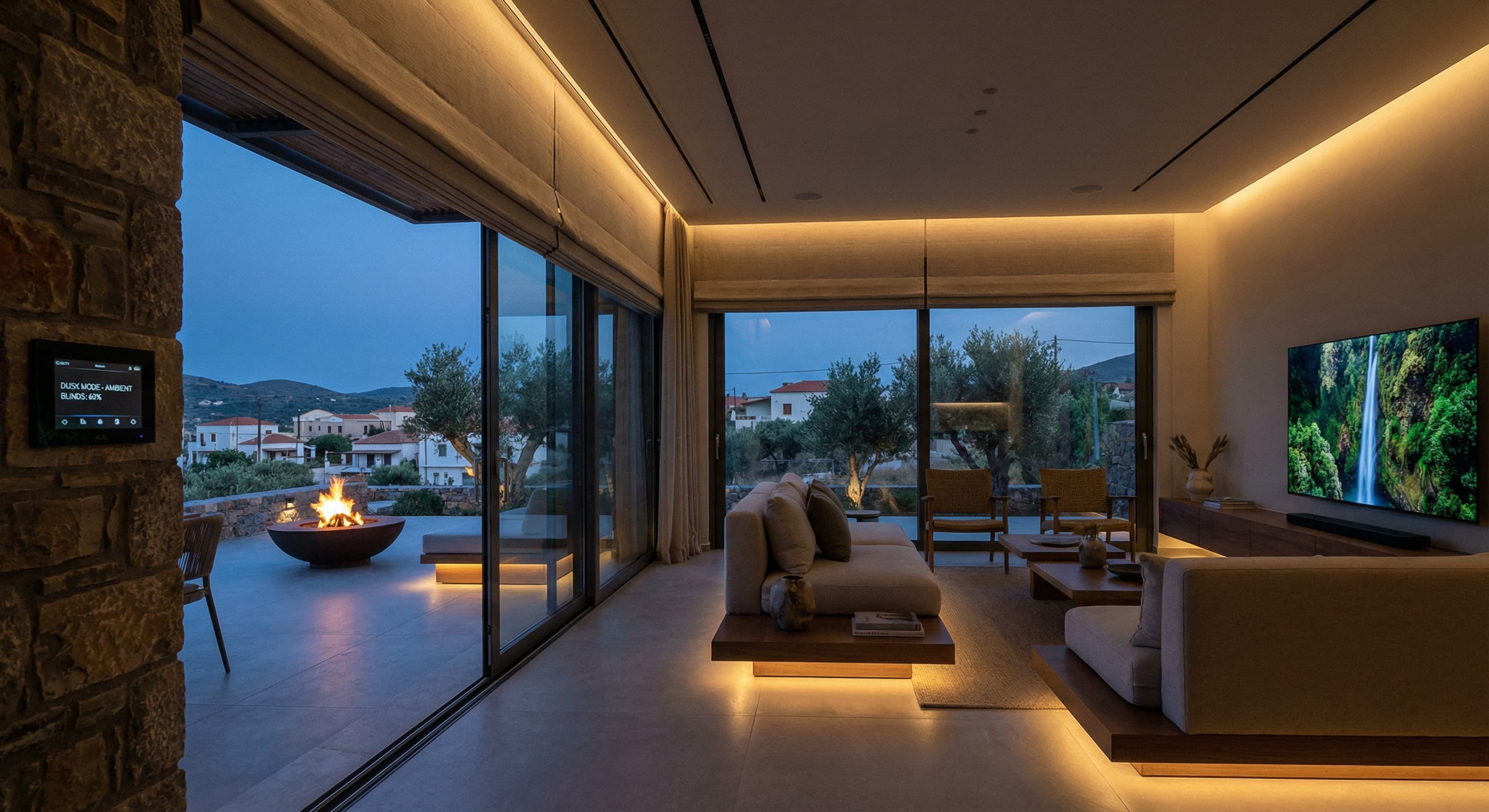
10 Things You Didn't Know a Smart Home Can Do

When someone hears the term smart home, they usually think of something simple: turning lights on from a phone or opening blinds from an app.
In reality, building automation can do much more. Not for show, but to improve daily life at home.
Below are ten functions many people do not realize can exist in a home - even in an apartment.
1) Adjust Heating Room by Room
In many homes, heating still runs from one thermostat.
That means:
- some spaces are too warm,
- others are cold,
- and more energy is consumed than necessary.
With automation:
- each area can have a different temperature,
- heating runs only where needed,
- energy consumption can be reduced significantly.
2) Create Daily "Scenes"
One button can trigger multiple actions at the same time.
For example, a "Good Night" scene can:
- turn off all lights,
- lower the blinds,
- arm the alarm,
- reduce heating.
With one action, the house is prepared for the night.
3) Simulate Presence When You Are Away
When we are away for hours or days, an empty home is easy to spot. The same lights stay off, blinds never move, and the house looks inactive.
With properly designed automation, a presence simulation scenario can be created. The system can trigger actions at natural times, as if someone were home:
- open or close blinds at specific times,
- turn on lights in different areas at night,
- turn lights off after a set period,
- activate lighting in different rooms each day.
The key point is that these scenarios do not have to be fully fixed. Small time variations can make the behavior look natural. To an external observer, the house appears occupied.
4) Shut Off Water on Leak Detection
A small water leak can cause major damage within hours.
With leak sensors:
- the system detects water on the floor,
- closes the main water supply automatically,
- and sends an alert to your phone.
This helps avoid expensive damage.
5) Turn Off Devices Left On by Mistake
How many times have we left home and wondered:
"Did I unplug the iron?"
"Did I turn off the stove?"
With smart power management:
- specific circuits can be switched off when you leave,
- the system can alert you for unusual consumption,
- power can be cut to high-risk devices.
The result is more safety - and less stress.
6) Dim Lights Automatically at Night
Lighting affects quality of life more than most people think.
An automation system can:
- adjust light intensity based on time,
- create different lighting scenes,
- reduce harsh light at night for a calmer atmosphere.
So the home feels better without constant manual adjustments.
7) Lower Shading Automatically in Strong Sun
In summer, solar heat through windows can dramatically increase indoor temperature.
A shading system can:
- lower blinds or shades automatically,
- reduce heat gain into the space,
- help AC operate more efficiently.
Small action - big energy impact.
8) Activate Lighting When You Pass By
Presence sensors can activate lighting only when needed.
For example:
- hallways,
- bathrooms,
- storage rooms,
- stairs.
The result:
- more comfort,
- more safety,
- lower energy consumption.
9) Notify You When Something Is Wrong
Your home can work like a sensor network.
It can alert you for:
- water leaks,
- smoke or fire,
- abnormal power consumption,
- an open door or window.
So you always know what is happening in your home.
10) Make the Home More Efficient and More Modern
Building automation is not just a technology feature.
It is infrastructure that improves the home overall:
- reduces energy usage,
- increases safety,
- improves daily comfort,
- increases property value.
A home with modern automation infrastructure is increasingly seen as more up-to-date and more attractive in the property market.
A Smart Home Is Not a Gadget - It Is Design
The real value of automation is not in apps or screens.
It is in the way the home is designed to:
- run more efficiently,
- protect the people living in it,
- make everyday life simpler.
And this can be applied to every home - from a small apartment to a large residence.
Related Articles
A 'Smart Home' Is Not a Luxury. It Is the Evolution of the Home.
Well-designed home automation is not about flashy gadgets. It is about comfort, safety, efficiency, and less daily stress.
Read more →
How an Existing Home Can Become 'Smart'
Home automation is not only for new builds. Learn how an already built home can be upgraded step by step with wireless solutions and minimal intervention.
Read more →