
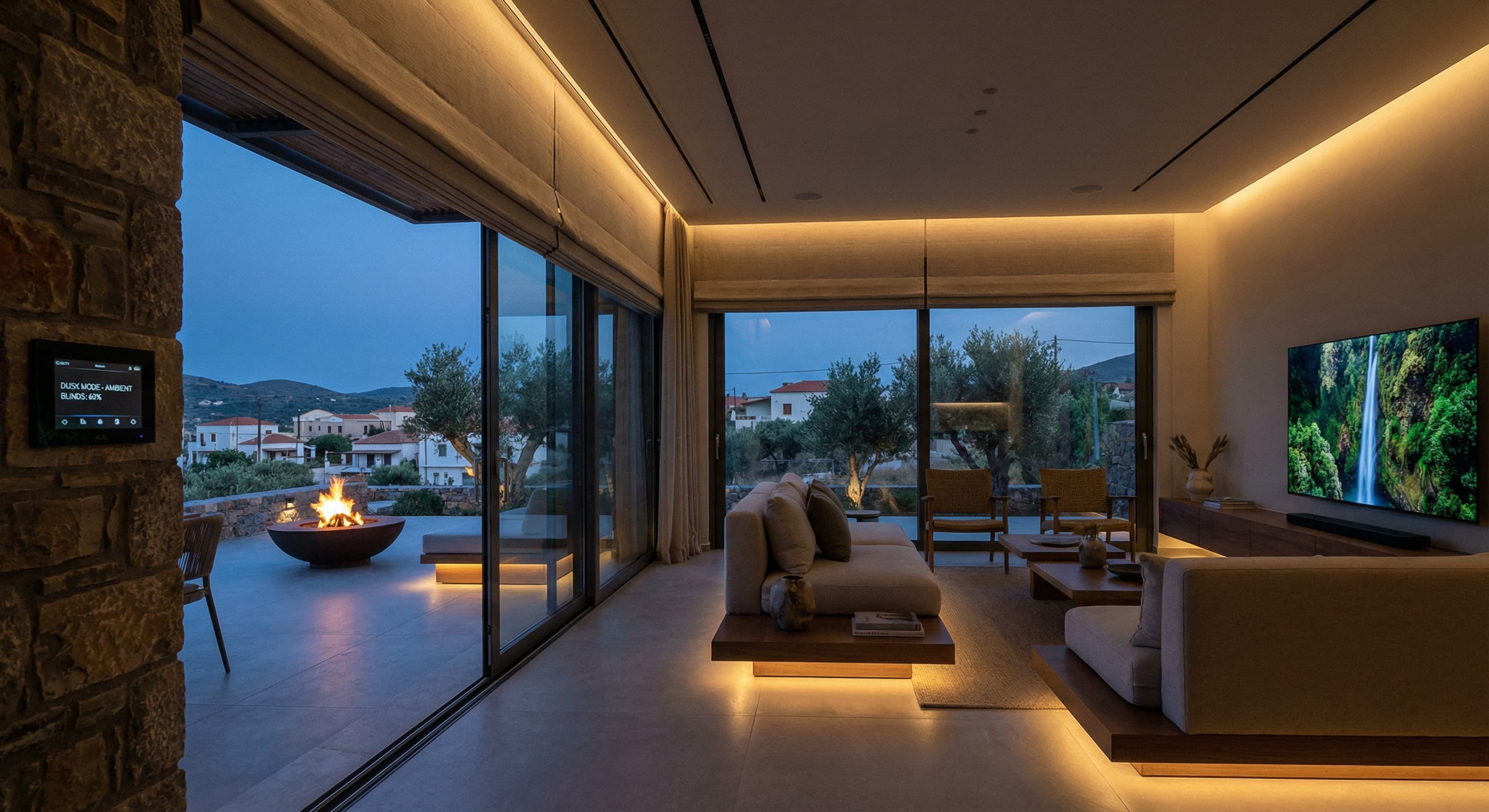
Dynamic Electricity Tariffs: How a Smart Home Turns Hourly Prices into Real Savings

Since April 1, 2026, dynamic electricity tariffs are available to residential consumers in Greece. PPC with myHome Dynamic, Protergia with Dynamic One Home, and other suppliers now offer contracts where the price per kilowatt-hour changes every hour, tracking the wholesale market.
What does that mean in practice? Electricity at sunny midday hours (when photovoltaics flood the grid) can cost very little, while evening peak hours cost several times more. The 24 hourly prices for the next day are published in advance, so in theory you can plan your consumption around them.
In theory. Because nobody is going to study a table of 24 prices every evening to decide when to run the washing machine.
The smart meter is your ticket in
A smart meter is the prerequisite for a dynamic tariff. HEDNO (the Greek distribution operator) is running the largest meter replacement programme in its history: roughly 2.4 million smart meters are expected to be operational by the end of 2026, targeting 7.7 million by 2030. If you don't have one yet, you can request priority installation through your supplier.
This is where automation comes in
A properly designed automation system (KNX or equivalent) with Home Energy Management reads the next day's price curve and decides on its own:
- Water heater / boiler: Heats water during the cheap midday hours so it's ready in the evening, without consuming a single kWh at peak prices.
- EV charging: The wallbox automatically charges during the 3–4 cheapest hours of the day. On an EV with a 60 kWh battery, the difference between cheap and expensive hours translates into tens of euros per month.
- Air conditioning & heat pump: Pre-cooling or pre-heating: the house cools or heats a little extra while electricity is cheap and "coasts" through the expensive hours, exploiting the building's thermal inertia.
- Washing machines, pool pumps, desalination: Every shiftable load is automatically scheduled into the cheap window.
If you also have solar with a battery, the system combines three sources (sun, battery, grid) and picks the cheapest one at any given moment. Under Greece's new net billing framework, where the value of your solar production depends on how well it coincides with your consumption, this synchronisation isn't a luxury: it is the return on your investment.
How much can you actually save?
International studies on dynamic pricing programmes report bill reductions in the range of 15–20% for households that consistently shift their loads. The critical word is consistently. And consistency without automation doesn't exist: people forget, systems don't.
A word of caution: dynamic tariffs are not for everyone. Households with rigid, evening-heavy consumption and no ability to shift loads may even end up paying more. That's why the right order is: automation and measurement first, tariff switch second.
The Sync-Teq philosophy
Dynamic tariffs are the first time the Greek grid actually rewards people with a smart home. At Sync-Teq we design KNX systems that don't just make your home more comfortable: they make it work for your electricity bill, every hour, every day, automatically.
Related Articles
Balcony Solar and Standalone Batteries in Greece: What the New Ministerial Decision Allows (ΦΕΚ Β 5573/2026)
Up to 800 W from your balcony, home batteries with zero grid export, and new net billing rules. What applies in Greece, what you need to connect, and how automation makes the investment pay off.
Read more →
Smart Home and Solar in Greece: How Automation Raises Self-Consumption Under Net Billing
Under net billing, energy you send to the grid is paid at the hourly wholesale price, which at midday often drops close to zero. What applies in Greece, what is changing, and how a smart home makes solar pay off.
Read more →