
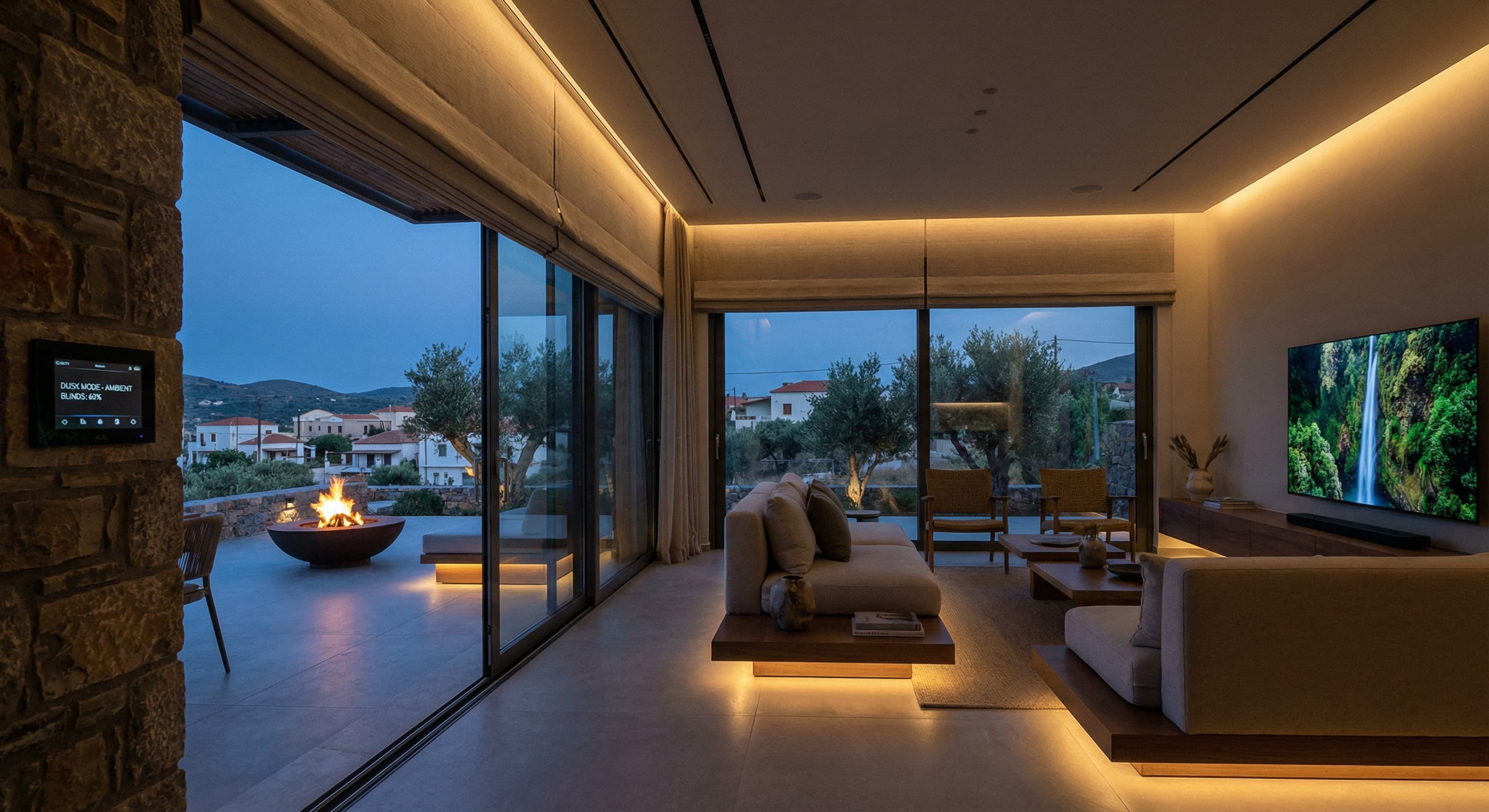
Shading Automation: Comfort, Savings, Privacy (and why 'Weather + Sun' matter more than you think)
If lighting is the most "visible" part of a smart home, shading/blinds is the most "underrated" — because it works silently and makes you wonder how you lived without it. With proper automation, blinds don't just "go up and down". They become a tool for:
- comfort (less heat/glare, better feeling of space)
- savings (reducing cooling/heating load)
- privacy (without living with closed shutters)
- equipment protection (furniture, floors, fabrics from UV)
- and in commercial spaces: more stable thermal comfort for customers/staff
And yes: here enter "smart" inputs like weather, sun, wind, temperature — even data from online weather services or local sensors.
1) Why Blinds Are "Invisible HVAC"
In practice, shading is passive air conditioning. If you cut solar radiation before it enters inside, you drastically reduce:
- overheating of the space,
- the need for intense cooling,
- peak loads.
In summer, a south/west living room with glass walls can raise temperature from the sun much faster than the AC can "catch up". Whereas with shading, you keep the space stable — and the HVAC works more calmly.
2) Comfort: "Not Blinding You" Is Just the Beginning
A mature shading system takes care of:
- anti-glare (no reflections on TV/screens)
- thermal comfort (less radiated heat near windows)
- light uniformity (the house doesn't become a "dark cave")
Especially with venetian blinds/louvers, you can achieve "light without glare", meaning natural light comes in but direct sun is cut.
3) Savings: Where Automation Shows Its Value
Economy doesn't come from "closing all blinds all day". It comes from proper strategy:
- summer: shade when there is solar gain that heats you up
- winter: let sun in when it benefits you (passive heating)
- intermediate seasons: balance (based on indoor/outdoor temperature)
So blinds are not just "privacy". They are an energy management tool that can significantly drop AC operating hours, especially in houses with large openings.
4) Privacy: Smart Isn't Closing — It's Respecting the Space
Most people close blinds for privacy and then live:
- with artificial light during the day,
- with a sense of "confinement".
Nice privacy is dynamic:
- "cutting" visibility from street/neighbor,
- but keeping light and open space feeling.
With a few presets (e.g. Privacy, Night, Away) the experience becomes simple: one button and done.
5) Shading Automation Needs Correct "Signals": Sun, Wind, Temperature, Rain
Here comes the interesting part: to become truly "smart", shading needs inputs beyond the clock.
(a) Sun (solar position) The most reliable input is the sun's position (azimuth/elevation) based on:
- latitude/longitude,
- time/date.
You don't need a "sun sensor" to know that at 17:30 the sun hits west. Astronomy knows. This is why many shading automations work excellently with sun-tracking.
(b) Local Weather Sensors (Weather Station) In more demanding projects (villas, hotels, large facades), you use meteorological sensors for:
- wind (wind alarm) — protecting awnings/blinds
- rain (rain alarm) — e.g. awnings/skylights
- temperature / brightness (lux) for better decisions
Here shows the difference of "professional" automation: we don't close awnings when we remember. They close when they must to avoid breaking.
(c) Online Weather Data (GPS/Location) Many platforms can pull weather data (forecast, wind, UV) based on location/GPS. This is useful when:
- you don't want/can't install a local sensor,
- you want "prediction" (e.g. storm coming → protection).
Note: online data is good as "context", but protection alerts (wind on awning) ideally rely on a local sensor — because wind is microclimatic.
6) "Smart" Shading Without Driving You Crazy (The Secret Is Exceptions)
The biggest mistake is a system that moves blinds constantly. A correct system:
- has hysteresis (not changing for small variations)
- has quiet hours (e.g. not raising blinds at 07:00 if it's weekend)
- has manual override that "sticks" (not canceling you after 2 minutes)
- respects scenes (Movie/Privacy/Sleep)
Automation should help you, not "scold" you.
7) What Fits Where (Residence vs Hotel)
Residence
- Anti-glare in living room/office
- Privacy scenes
- Summer shading / winter sun gain
- Wind protection on awnings
Hotel
- Stable comfort for guests (fewer complaints)
- Cooling load reduction especially in rooms with south/west facades
- Central shading policy per floor/facade
- Equipment protection (huge cost in awnings/external blinds)
Conclusion
Shading automation is one of the highest ROI parts because:
- it improves comfort immediately,
- reduces HVAC needs,
- gives privacy without darkening the house,
- and protects external systems from wind/weather.
And the best part? When designed correctly, it is invisible: you just feel that the space is always "as it should be".
Related Articles
HVAC Automation: Zones, Thermostats, Interlocks — 'Don't Fight the HVAC'
HVAC is where 'smart home' can make the biggest difference. The most useful principle: Don't fight the HVAC. Cooperate with it.
Read more →
HEDNO (ΔΕΔΔΗΕ) smart meters in Greece: what data they provide, what the H1 port is and how a smart home uses it
HEDNO is installing thousands of smart meters a day across Greece. What they record, where you see your data, why the H1 port is not yet available to households, and how home automation gets real-time energy data today.
Read more →