
Wireless KNX (KNX RF): a Smart Home Renovation Without Chasing Walls
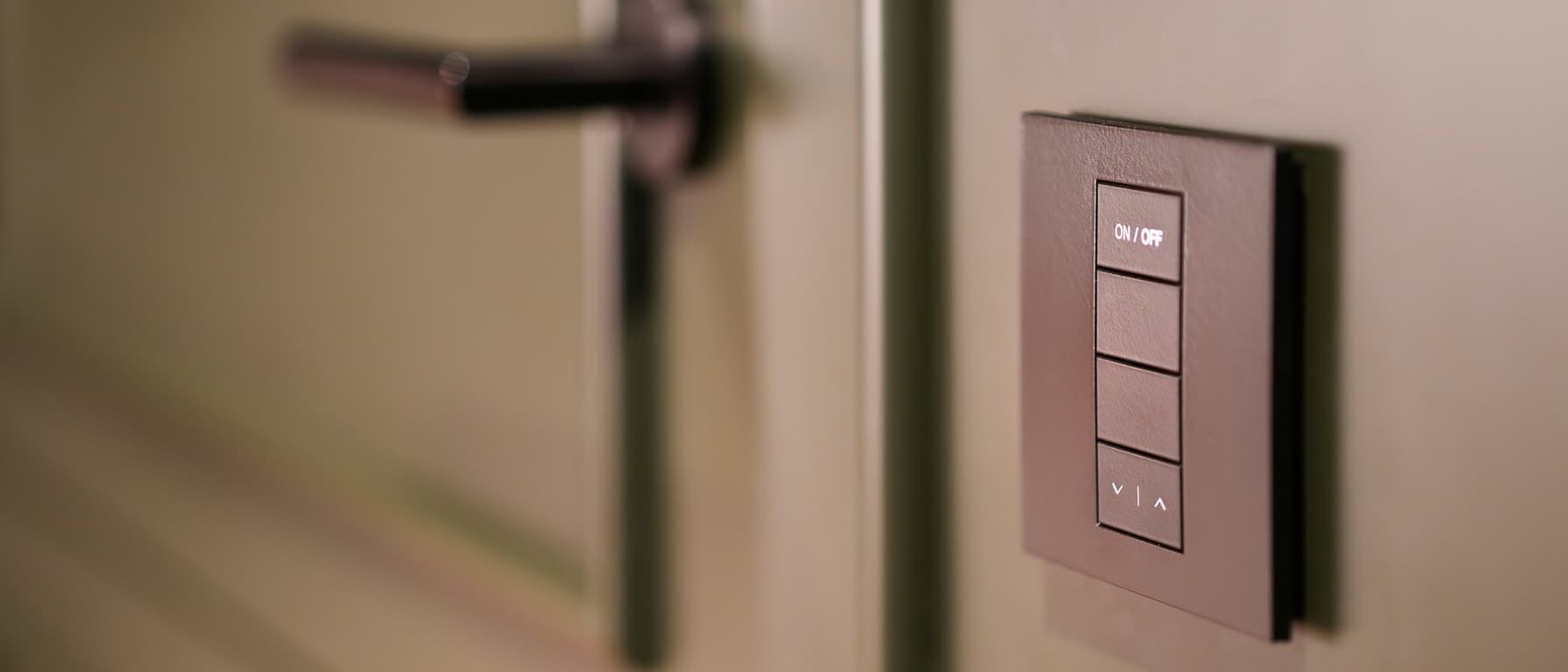
In short: KNX RF is the wireless part of the same KNX standard used in professional wired installations. It lets an existing home gain wireless push buttons, sensors, window handles and radiator thermostats without chasing walls. Crucially, it is not a separate "gadget" system. It is programmed in the same tool (ETS), combines with wired KNX and can grow with the home.
In our earlier article on making an existing home smart we looked at what is possible. Here we explain the technology that does the job professionally.
How KNX RF works
- 868 MHz band. It passes through walls better than 2.4 GHz Wi-Fi and does not share a channel with the home network.
- KNX RF Multi. The newer version uses several channels, checks that a channel is free before transmitting, quickly acknowledges every message with automatic retries and supports repeaters.
- Media coupler. A device in the panel (for example Gira's RF/TP media coupler) bridges wireless and wired KNX. It can also act as a repeater for wider coverage.
- Security. Current couplers and many wireless devices support KNX Data Secure: messages are encrypted and authenticated.
- One tool. Everything is programmed in ETS, just like a wired installation. No cloud, manufacturer app or internet connection is needed for it to work.
What wireless KNX offers today
Some examples from manufacturers' catalogues:
| Device | What it solves in a renovation |
|---|---|
| Battery push buttons (e.g. Gira) | A new control point on any wall, no cable |
| Wireless window handle (e.g. MDT KNX RF+) | Knows if the window is closed, open or tilted. Switches off the air conditioning when the window opens and gives a vibration alert |
| Wireless radiator thermostat with display (e.g. MDT KNX RF+) | Per-room temperature control on radiators, no plumbing work |
| RF/TP media coupler (e.g. Gira) | The bridge to wired KNX and a repeater for range |
On power: MDT quotes up to 8 years of battery life for its window handle thanks to DeepSleep. On range, manufacturers typically quote 100 to 150 metres in free field, less inside a building.
The hybrid model: a little cable, a lot of wireless
In practice, the best renovations are not "100% wireless". They are hybrid:
- In the electrical panel, wired KNX actuators for lights, blinds and air conditioning. The panel is opened in a renovation anyway, and cable there costs nothing extra in disruption.
- On the walls, where we want to avoid chasing, wireless push buttons, presence sensors, window handles and radiator thermostats.
- A media coupler joins it all into one system, with shared scenes, one app and one programming.
The home gets the stability of wired KNX where it matters and the flexibility of wireless where cable would cost too much.
KNX RF or Matter?
Matter is a welcome step for consumer devices: bulbs, plugs and locks that work together. For a complete installation in a renovation, the differences are practical:
| KNX RF | Matter | |
|---|---|---|
| Programming | Professional, in ETS | Consumer apps and controllers |
| Combines with wired system | Yes, in the same project | Through a gateway |
| Works without internet | Fully | Usually locally, depends on the controller |
| Installation lifespan | Decades, with backward compatibility | Newer standard, evolving fast |
They are not necessarily rivals: a KNX system can work with Matter devices through a suitable gateway. For a fuller comparison, see our protocols guide.
When cable is still the better choice
- New builds or full renovations with open walls: wired KNX costs less per point and has no batteries.
- Many metal frames or heavily reinforced concrete reduce range and require repeaters.
- Always-on devices, such as touch panels and central controllers, are always simpler wired.
What to ask your installer
- A coverage survey before buying, with positions for couplers and repeaters.
- KNX Data Secure on the coupler and devices.
- A hybrid plan: what goes in the panel and what goes wireless.
- A battery replacement plan and low-battery alerts in the app.
- Handover of the ETS project, so the system is yours and not locked to one installer.
How Sync-Teq helps
We design renovations where KNX automation goes in with as little disruption as possible: cable where it makes sense, wireless where it saves chasing walls, and one system that runs locally, without cloud dependency. Contact us for a site visit.
Sources
Frequently asked questions
Can I install KNX without opening walls?+
Largely, yes. KNX RF is the wireless part of the KNX standard: push buttons, sensors, window handles and radiator thermostats run on batteries and communicate wirelessly. Usually a small wired section in the electrical panel connects to the wireless devices through a media coupler.
What is KNX RF Multi?+
It is the evolution of KNX RF. It uses several channels in the 868 MHz band, checks that a channel is free before transmitting (listen before talk), quickly acknowledges every message with automatic retries and supports repeaters. The result is more reliable communication in homes with many walls.
How long do batteries last in wireless KNX devices?+
It depends on the device and its use. As an example, MDT quotes up to 8 years of battery life for its KNX RF+ window handle thanks to its DeepSleep mode. Gira's wireless push buttons use a standard lithium coin cell.
Is wireless KNX secure?+
Current KNX RF devices and media couplers support KNX Data Secure, meaning messages are encrypted and authenticated. It is worth requiring it explicitly in the specification.
KNX RF or Matter for an apartment renovation?+
Matter is a good solution for individual consumer devices. KNX RF fits when you want one professionally programmed system that runs locally, combines products from many manufacturers and can later be extended with wired KNX in the same ETS project.
What is the range of KNX RF?+
Manufacturers typically quote around 100 to 150 metres in free field. Indoors the range drops through walls, slabs and metal frames, so larger homes use repeaters or a second media coupler.
Related Articles
How an Existing Home Can Become 'Smart'
Home automation is not only for new builds. Learn how an already built home can be upgraded step by step with wireless solutions and minimal intervention.
Read more →
Smart Home is not a Wi-Fi bulb — it's the system
Most people start with a Wi-Fi bulb. But that's usually remote control, not automation. A truly smart home is infrastructure: reliable, logical, scalable.
Read more →