

Zigbee 4.0 and Suzi: what changes in the smart home and what it means for the devices you already own
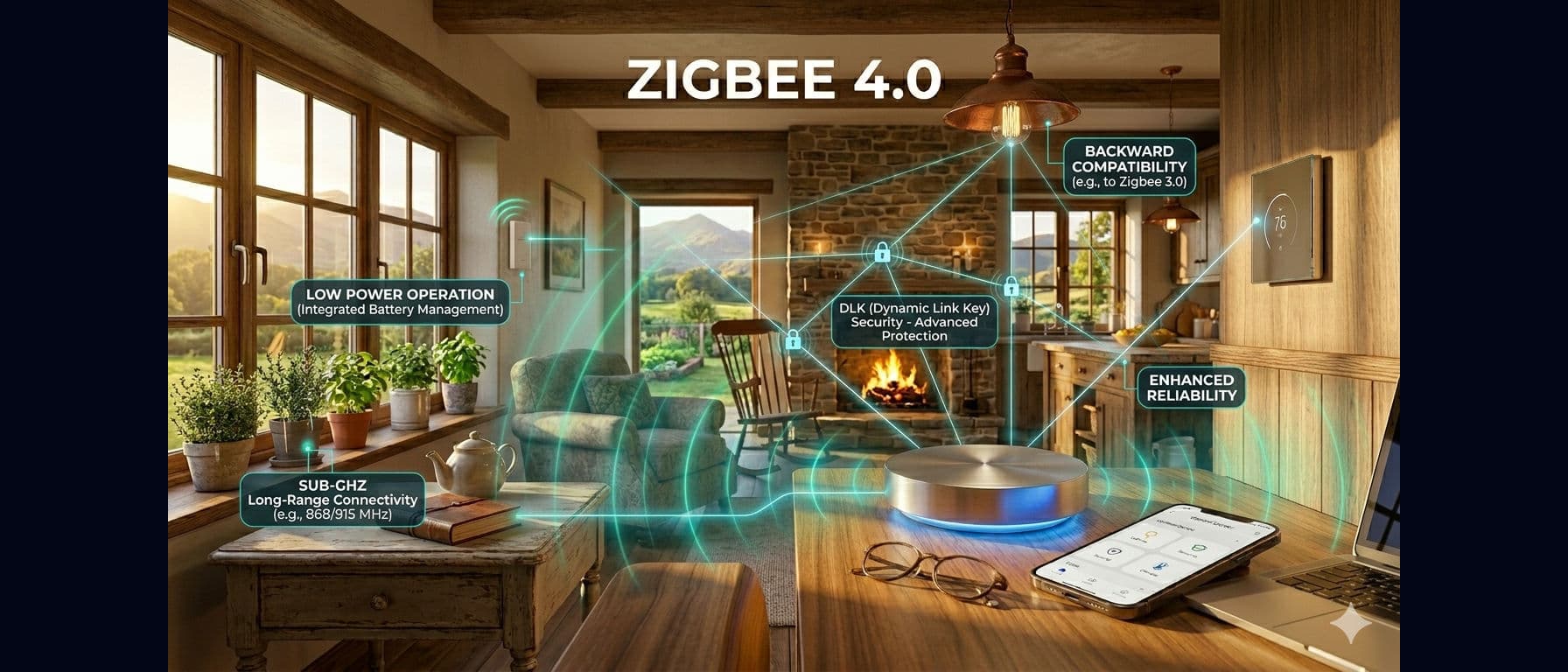
In short: Zigbee 4.0 was announced by the Connectivity Standards Alliance on 18 November 2025. It does not change how Zigbee works, but it makes it more secure and more reliable: safer pairing, hub replacement without re-pairing every device, batch commissioning and fewer lost messages. Alongside it came Suzi, sub-1 GHz Zigbee for longer range, with product certification opening on 2 September 2026. The Zigbee 3.0 devices you own keep working as before. We have not seen Suzi devices on the market yet.
Zigbee has long been the protocol behind millions of smart bulbs, sensors and plugs. The CSA cites more than a billion Zigbee devices deployed. Below we explain what changes in practice, what to look for when buying devices, and where Zigbee belongs in a complete automation system.
The new features at a glance
The CSA describes Zigbee 4.0 as a set of optional features: each manufacturer picks the ones that suit its product. So a "Zigbee 4.0" label alone does not guarantee that a device has everything below.
| Feature | What it does | What you gain in practice |
|---|---|---|
| Dynamic Link Key (DLK) | Secure key negotiation during onboarding and key rotation after upgrades | Much harder to eavesdrop during pairing |
| Device Interview | The central node checks a device before accepting it | Only trusted devices join the network |
| Trust Center Swap-Out | Replace the central controller without re-commissioning devices | If the hub dies, you do not re-pair 40 devices one by one |
| Restricted Mode | Only the Trust Center can change a device's operational state | Unauthorised network changes become harder |
| Advanced Frame Counter Synchronization | Synchronised message counters | Protection against replay attacks |
| Network-level retries, more APS acknowledgements | Standardised message retry mechanism | Fewer commands that get lost |
| Coordinated Sample Listening (CSL) | Direct communication between battery devices | Longer battery life |
| Batch Commissioning | Onboard many devices at once | Faster installation in homes and commercial spaces |
| Zigbee Direct | Onboard and control from a phone over Bluetooth Low Energy, without a hub | Simple initial setup |
| New sub-1 GHz PHY (Suzi) | 800 MHz Europe, 900 MHz North America | Longer range and better wall penetration |
Zigbee 4.0 also starts harmonising classic Zigbee with Zigbee Smart Energy, the profile used in smart meters in several markets, and remains compatible with it.
Security: the most meaningful change
Most security problems in home wireless networks appear at the moment a new device joins, or when a network runs for years with the same keys. Zigbee 4.0 targets exactly that:
- With Dynamic Link Key, the key is not exchanged in a way that is easy to intercept during pairing, and it can be rotated after an upgrade.
- With Device Interview and authentication level control, the network can refuse devices that do not meet its requirements.
- With Restricted Mode, PAN ID changes and Secured Channel, tampering with the network structure becomes harder.
This ties in with the new European rules for connected devices. As we explain in our article on the Cyber Resilience Act, manufacturers will have to show that their products stay secure throughout their lifetime. A standard with built-in key rotation and device checks helps in that direction.
Trust Center Swap-Out: no more "re-pair everything"
Anyone who has replaced a Zigbee coordinator knows the problem: in most cases every device had to be paired again, one by one, often from a ladder to press the button on a ceiling light.
Trust Center Swap-Out allows the central controller (a hub, smart speaker or smart meter, according to the CSA) to be replaced without re-commissioning devices. For a home with dozens of sensors, this may be the most practical improvement in the new standard. It only works when both the devices and the new controller support it.
Suzi: Zigbee below 1 GHz
Until now Zigbee has in practice run at 2.4 GHz, the same band as Wi-Fi and Bluetooth. In apartment buildings with dozens of neighbouring Wi-Fi networks, that means interference, and concrete walls cut the range noticeably.
Suzi is the new name for Zigbee at sub-1 GHz frequencies. The CSA cites an 800 MHz band for Europe and 900 MHz for North America. A lower frequency means longer range and better penetration through walls and slabs. The CSA targets Suzi at homes, outdoor spaces, buildings and city applications.
Three things worth knowing:
- It is an extension, not a replacement. 2.4 GHz Zigbee carries on as before.
- It needs new hardware. The popular Zigbee USB sticks (for example those with Silicon Labs EFR32MG21/MG24 or TI CC2652P chips) are 2.4 GHz only. A software update will not turn them into Suzi devices.
- There are no products on the shelves yet. Suzi product certification opened on 2 September 2026 and the first certifications were for software stacks. As of October 2026 we found no Suzi end devices on sale, and no support in the popular open tools (ZHA, Zigbee2MQTT).
Interestingly, sub-1 GHz is the same approach wireless KNX (KNX RF) has used for years at 868 MHz, precisely for better penetration in buildings.
Zigbee Direct: setup from your phone
Zigbee Direct lets you onboard and control a Zigbee device from your phone over Bluetooth Low Energy, without a hub. It is useful for first setup and for small applications with a few devices.
For a real smart home, though, the central controller remains essential: it runs the scenes, schedules, links to other systems and remote access. The difference between "I control a bulb from my phone" and a home that runs itself is what we describe in system vs gadget.
Zigbee 3.0 vs 4.0: what it means for the devices and gateway you already own
- Zigbee 3.0 devices keep working. The CSA states full backward compatibility with Zigbee 3.0 and Smart Energy.
- Do not expect mass upgrades. Signify, which helped develop Zigbee 4.0, has said it currently has no information about a changeover for Philips Hue.
- New features need support on both sides. A network with an older coordinator will not gain Trust Center Swap-Out because you added one new bulb.
- You do not need to throw anything away. If your network works well today, Zigbee 4.0 is a reason to prefer certified devices in future purchases, not a reason to replace things now.
Practical tips for a stable Zigbee network today
Most problems we see in Zigbee networks are not about the protocol version but about the design:
- Pick a channel that avoids Wi-Fi. Zigbee channels 15, 20 and 25 sit between the common Wi-Fi channels 1, 6 and 11. Planning the home network properly helps both.
- Keep the coordinator away from the router and USB 3.0 ports. A short USB extension cable often makes a big difference.
- Build the mesh with mains-powered devices. Plugs and bulbs act as repeaters. Battery sensors do not.
- Prefer local control. A controller that runs locally, without the cloud keeps working when the internet is down.
- For new purchases, ask for Zigbee 4.0 certification and check which optional features the device supports.
Where Zigbee fits in a professional system
In our installations, the core automation of the home (lighting, shading, climate, energy) is usually built on KNX, which is professionally programmed and lasts for decades. Zigbee has a supplementary role:
| KNX | Zigbee | Matter | |
|---|---|---|---|
| Role | Core infrastructure of the home | Affordable supplementary devices | Interoperability of consumer devices across ecosystems |
| Programming | Professional, in ETS | From a controller or app | From consumer apps and controllers |
| Medium | Cable, IP and RF at 868 MHz | Wireless 2.4 GHz, plus sub-GHz with Suzi | Thread, Wi-Fi, Ethernet |
| Lifetime | Decades, with backward compatibility | Good backward compatibility | Newer standard, evolving fast |
With a suitable gateway, a Zigbee sensor can trigger a KNX scene and vice versa. For a more detailed comparison of protocols, see our protocols guide.
How Sync-Teq helps
We design systems where each technology goes where it makes sense: KNX for the infrastructure, wireless devices where they save chasing walls or cost, and a properly built network underneath. If you already have Zigbee devices and want them integrated into one stable system, get in touch.
Sources
Frequently asked questions
What is Zigbee 4.0?+
It is the new version of the Zigbee wireless standard, announced by the Connectivity Standards Alliance (CSA) on 18 November 2025. It mainly brings security improvements (Dynamic Link Key, Device Interview, Trust Center Swap-Out, Restricted Mode), a more reliable network, batch commissioning and support for sub-1 GHz frequencies through Suzi.
Will my Zigbee 3.0 devices work with Zigbee 4.0?+
Yes. The CSA states that Zigbee 4.0 is fully backward compatible with Zigbee 3.0 and Smart Energy. Your existing devices keep working. The new features, however, only work when both the device and the coordinator support them.
What is Suzi?+
Suzi is the name for Zigbee in sub-1 GHz bands (800 MHz in Europe and 900 MHz in North America, according to the CSA). It offers longer range and better wall penetration. It does not replace 2.4 GHz Zigbee, it extends it. Suzi product certification opened on 2 September 2026.
Can I buy Suzi devices today?+
As of October 2026 we found no Suzi devices on sale. The first certifications were for software stacks, not end products. In addition, the popular Zigbee USB sticks are 2.4 GHz only, so Suzi will require new hardware.
Do I still need a hub with Zigbee 4.0?+
Zigbee Direct lets you onboard and control devices from your phone over Bluetooth Low Energy without a hub. For automations, scenes and remote access you still need a central controller, such as Home Assistant or a gateway that links Zigbee to KNX.
Zigbee or KNX for a home?+
They are not necessarily competitors. KNX suits the core automation of the home (lighting, shading, climate) with professional programming and a lifetime of decades. Zigbee is an affordable option for supplementary devices such as sensors, smart bulbs and plugs, which can join the same system through a gateway.
Related Articles
KNX vs Zigbee / Z-Wave / Thread / Matter: What Goes Where (Wired Backbone, Wireless Edge)
What should be infrastructure (backbone) and what can be edge? A practical guide to correct Smart Home architecture.
Read more →
New build or renovation: what to plan now for a smart home
Whatever goes into the walls before plastering costs little. Whatever goes in afterwards costs a lot. A practical checklist for homeowners and architects: KNX cable, distribution board, wall boxes, blinds, network, AV and EV charging.
Read more →